#DanceMuse: Folk Culture, Interdisciplinarity and Innovation in a Hybrid Museum of Traditional Dance
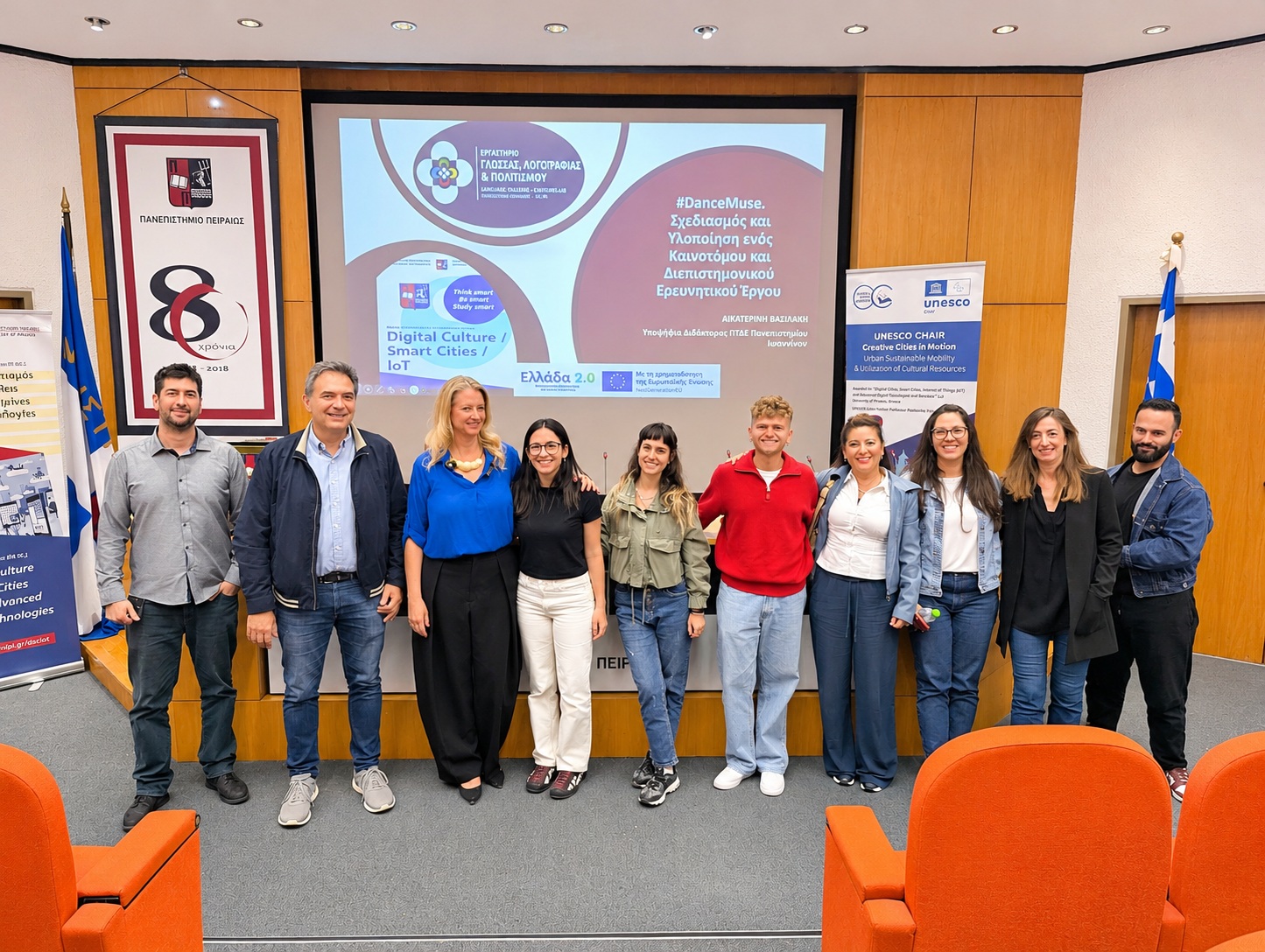
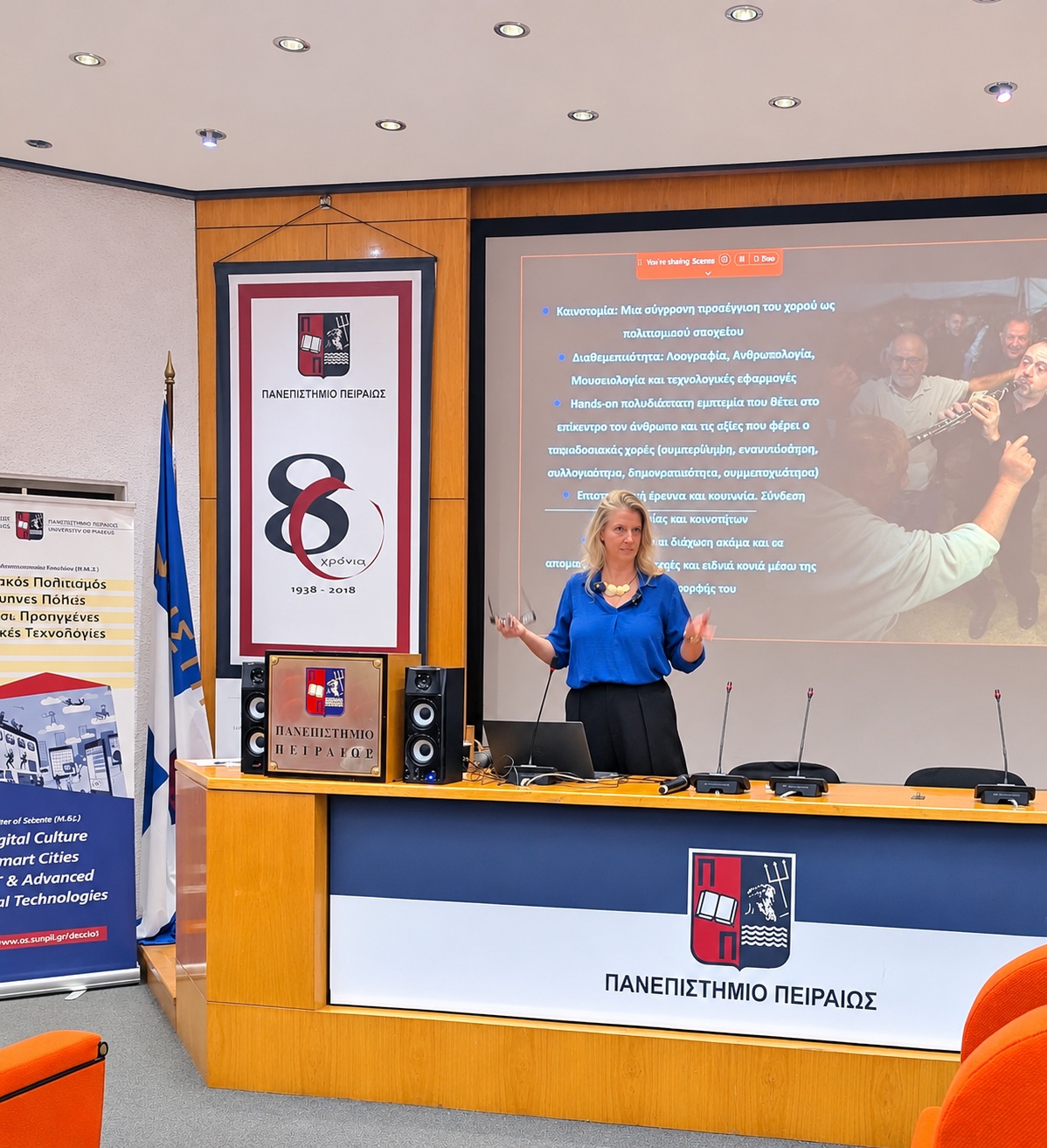
The innovative research project #DanceMuse – Hybrid Museum of Traditional Dance, which brings together cultural heritage and contemporary digital technologies, was presented at the University of Piraeus during an open lecture entitled “#DanceMuse: Design and Implementation of an Innovative Interdisciplinary Research Project.”
The lecture took place in the Conference Hall of the University of Piraeus' main building as part of the educational activities of the Master's Programme in Digital Culture, Smart Cities, IoT and Advanced Digital Technologies. The Programme is directed by Professor Dimitrios D. Vergados, who also serves as Director of the Digital Culture, Smart Cities, Internet of Things (IoT) and Advanced Digital Technologies and Services Laboratory (DigiLab) and Chairholder of the UNESCO Chair “Creative Cities in Motion: Urban Sustainable Mobility and Utilization of Cultural Resources.”
The #DanceMuse project emerged from an interdisciplinary partnership between the Laboratory of Language, Folklore and Culture at the University of Ioannina, directed by Professor Christos Papakostas, the project's Scientific Coordinator, and DigiLab at the University of Piraeus, directed by Professor Dimitrios D. Vergados, in collaboration with Internet Business Hellas, Toolbox Consulting Services and Interoptics. The research project ran from April 2025 to June 2026, bringing together academics, researchers, museum studies specialists, visual artists and professionals from various fields.
The project's central objective is to present traditional dance as a living, experiential form of cultural heritage, with particular emphasis on the region of Epirus. Through a contemporary museological narrative, it connects living cultural heritage with technology and the arts. #DanceMuse creates a phygital museum experience, integrating physical and digital spaces into a complementary environment and drawing on original ethnographic fieldwork and selected archival materials.
The presentation highlighted the project's principal technological and museological applications, including a 3D digitisation system for museum materials, motion capture technology for recording dance movements and transforming them into digital models, and a Virtual Reality (VR) application offering users an immersive experience within an interactive 360-degree environment.
A particularly innovative feature of #DanceMuse is its mobile, modular hybrid exhibition model, which combines physical exhibition space with digital applications. Exhibition installations, photographic documentation, QR-code-enabled interactive content, ethnographic videos and a central immersive VR installation create an environment based on the principles of participation, accessibility and experiential engagement.
Katerina Vasilaki, a PhD candidate at the University of Ioannina specialising in Ethnographic Approaches to Folk Culture and a collaborator at the University of Piraeus DigiLab, delivered the presentation. Within the #DanceMuse project, she coordinated the teams throughout all stages of implementation, led the conceptual museological design and contributed to the University of Ioannina's research team.
The lecture demonstrated how interdisciplinary collaboration across Museology, Folklore Studies, Anthropology, Computer Science, Cultural Management and the Arts can open up new approaches to documenting, interpreting and communicating living cultural heritage. Through multimodal ethnographic fieldwork and the digitisation of both tangible cultural materials and dance movements, #DanceMuse seeks to translate dance as a cultural phenomenon into the digital realm while preserving its experiential and social dimensions.
The project “Hybrid Museum of Traditional Dance” (#DanceMuse – ΥΠ3ΤΑ-0561372) was implemented under “SUB1.1: Research Excellence Partnerships”, part of the “Strategy for Excellence in Universities and Innovation” (ID 16289) initiative, within Greece 2.0 – National Recovery and Resilience Plan, with funding from the European Union – NextGenerationEU.